2026 Edition · Version 1.1 · Instant PDF download
A calmer household, in ninety days.
Most preparedness advice is either panic or paperwork. This is a 100-page field guide that turns it into 47 clear actions, 14 printable worksheets, and one 90-day plan — so an ordinary disruption stops becoming an emergency.
$49 one-time · not a subscription
- Instant PDF download
- Read on phone, tablet, or print it
- No subscription, no account needed
- 14-day money-back guarantee
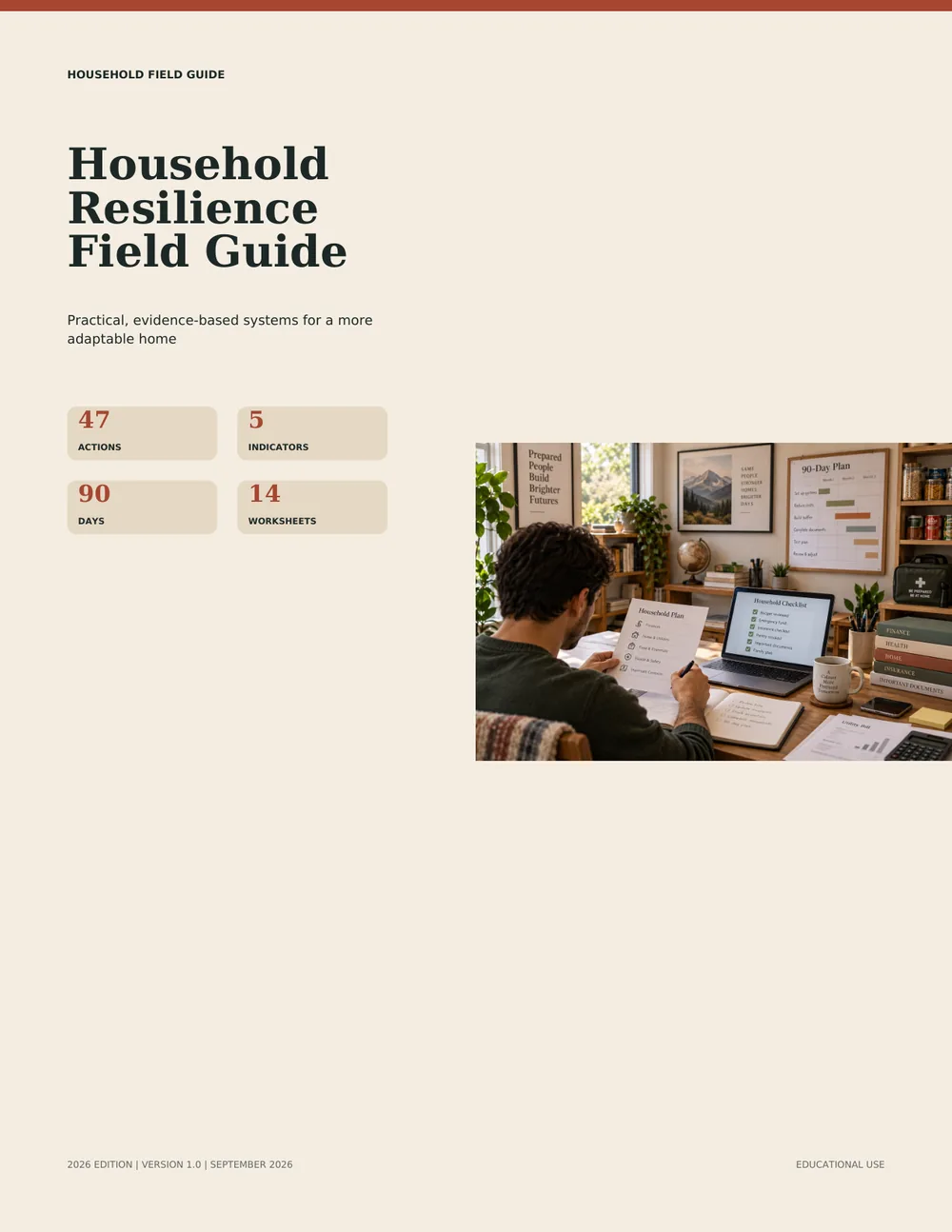
- 100Pages
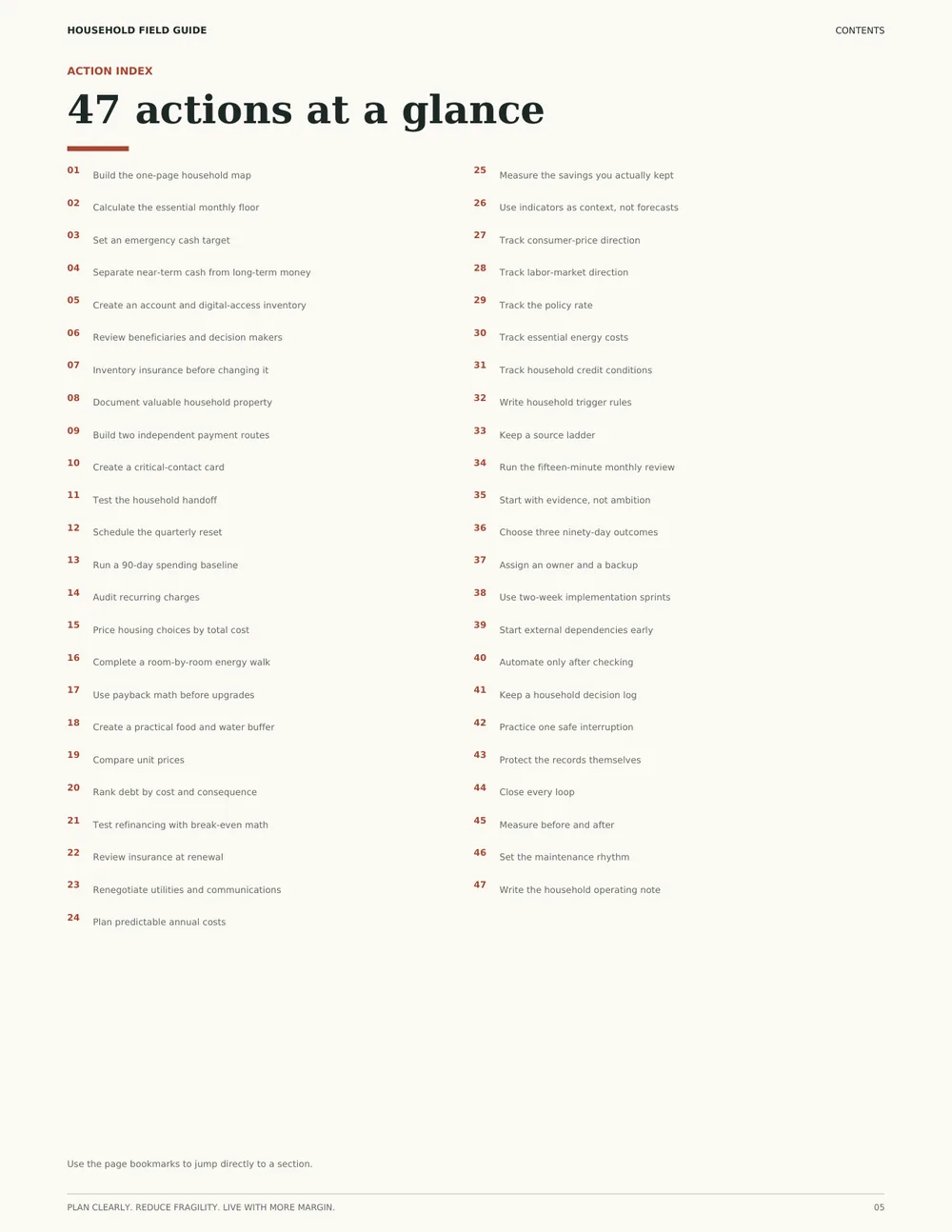
- 47Actions
- 5Indicators
- 90Days
- 14Worksheets
Why this exists
You do not need to predict the next crisis.
You need a household that can absorb ordinary disruption — a job change, higher costs, severe weather, a power outage, an unexpected bill — without turning every decision into an emergency.
Not prediction
Nobody can tell you what happens next, and anyone selling that certainty is selling something else. This guide builds margin instead.
Not panic
No bunkers, no hoarding, no doom. A resilient household rarely looks dramatic — it looks like current documents and known costs.
Not a reading list
Every page ends in something you can finish. Information is only useful when it becomes a dated decision or a tested routine.
The method
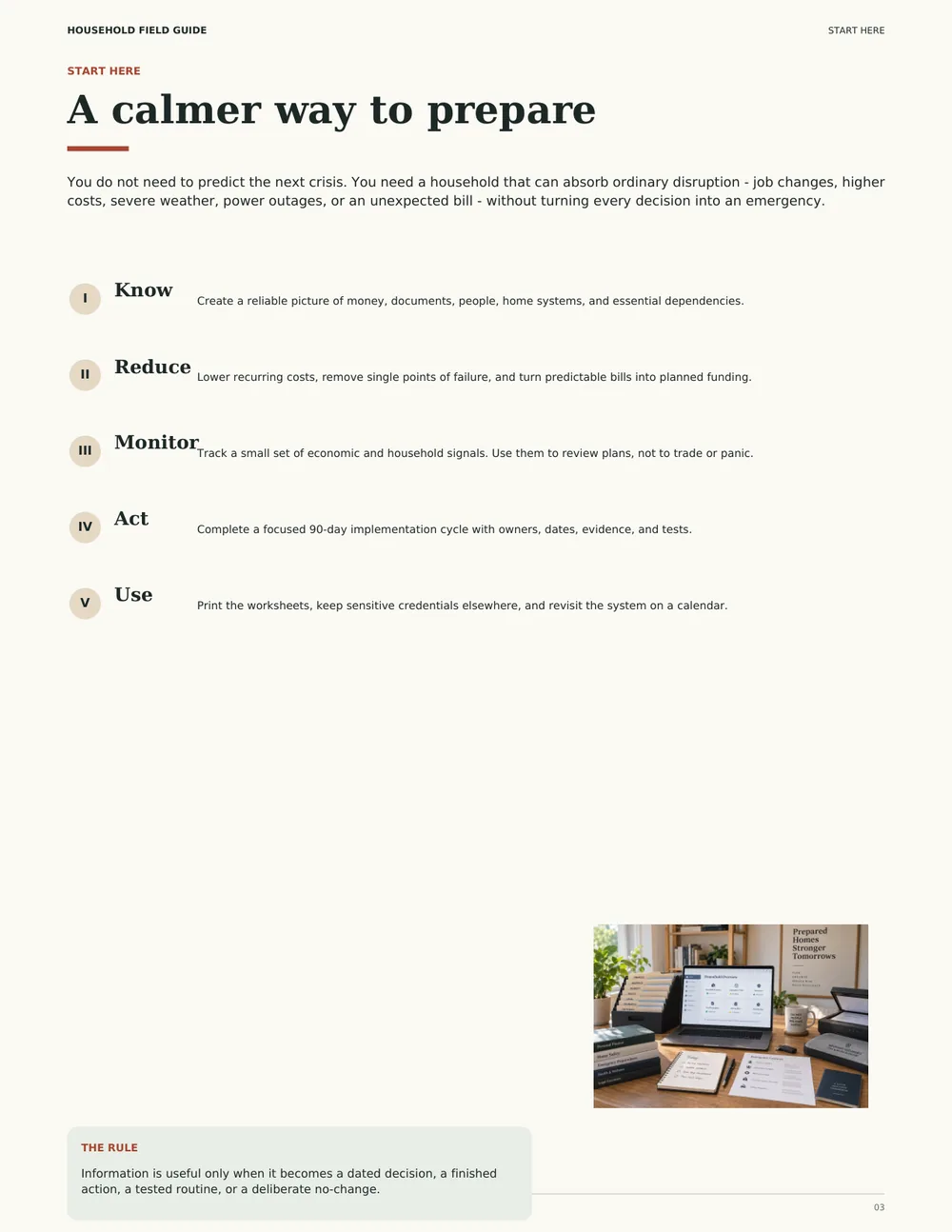
Five stages, in order
Each stage builds on the one before it. You always know where you are and what comes next.
-
I
Know
Create a reliable picture of money, documents, people, home systems, and essential dependencies.
-
II
Reduce
Lower recurring costs, remove single points of failure, and turn predictable bills into planned funding.
-
III
Monitor
Track a small set of economic and household signals. Use them to review plans, not to trade or panic.
-
IV
Act
Complete a focused 90-day implementation cycle with owners, dates, evidence, and tests.
-
V
Use
Print the worksheets, keep sensitive credentials elsewhere, and revisit the system on a calendar.
What is inside
Four parts and three companions
Part 1 — Know
Actions 01–12
Build a clear picture of the household before changing it: what exists, what is due, where it is held, and who can act.
Part 2 — Reduce
Actions 13–25
Lower recurring costs, remove single points of failure, and turn predictable bills into planned funding.
Part 3 — Monitor
Actions 26–34
Track a small set of economic and household signals — and use them to review plans, not to trade or panic.
Part 4 — Act
Actions 35–47
Run a focused 90-day cycle with owners, dates, evidence, and tests, so intentions become finished work.
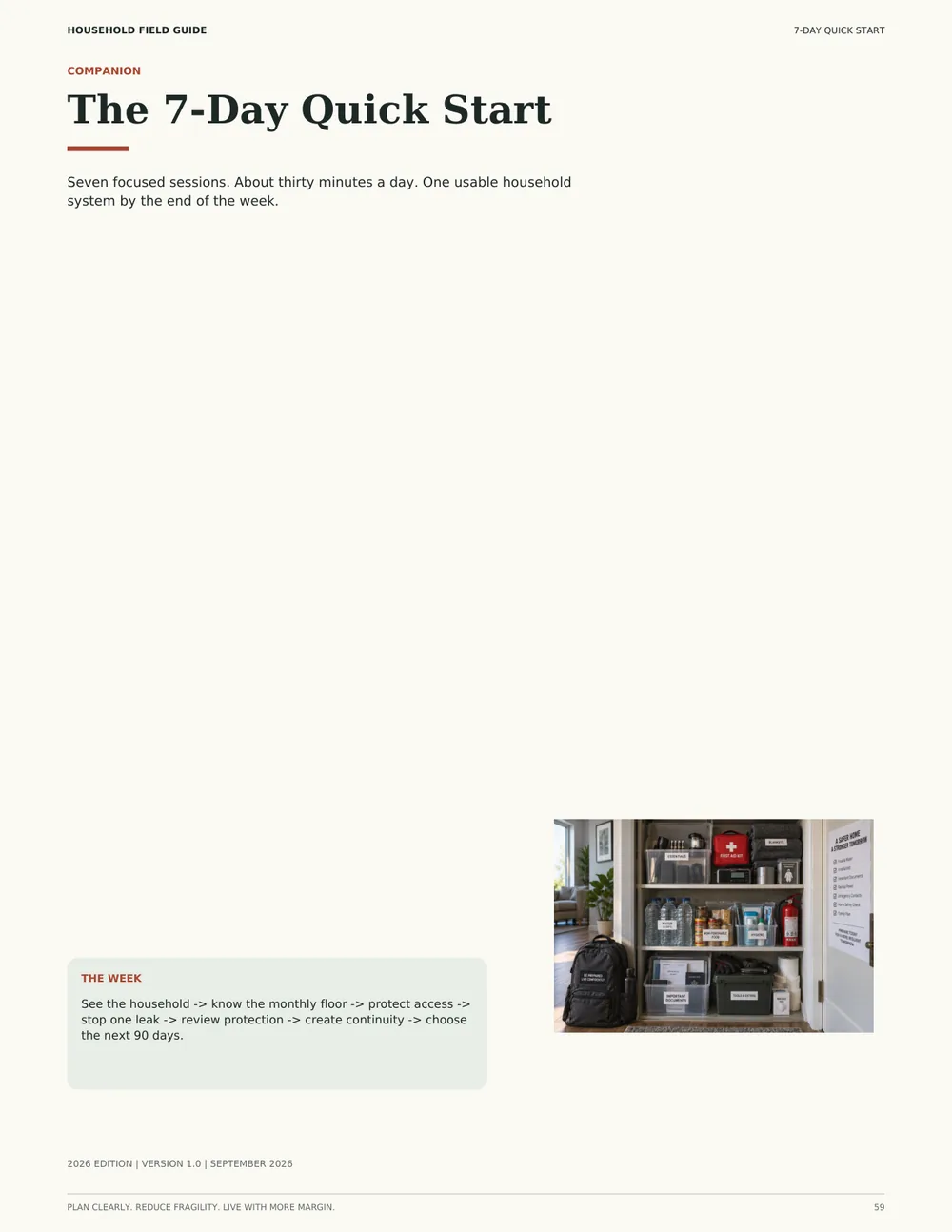
The 7-Day Quick Start
Seven focused sessions, about thirty minutes a day. One usable household system by the end of the week — before you touch the longer plan.
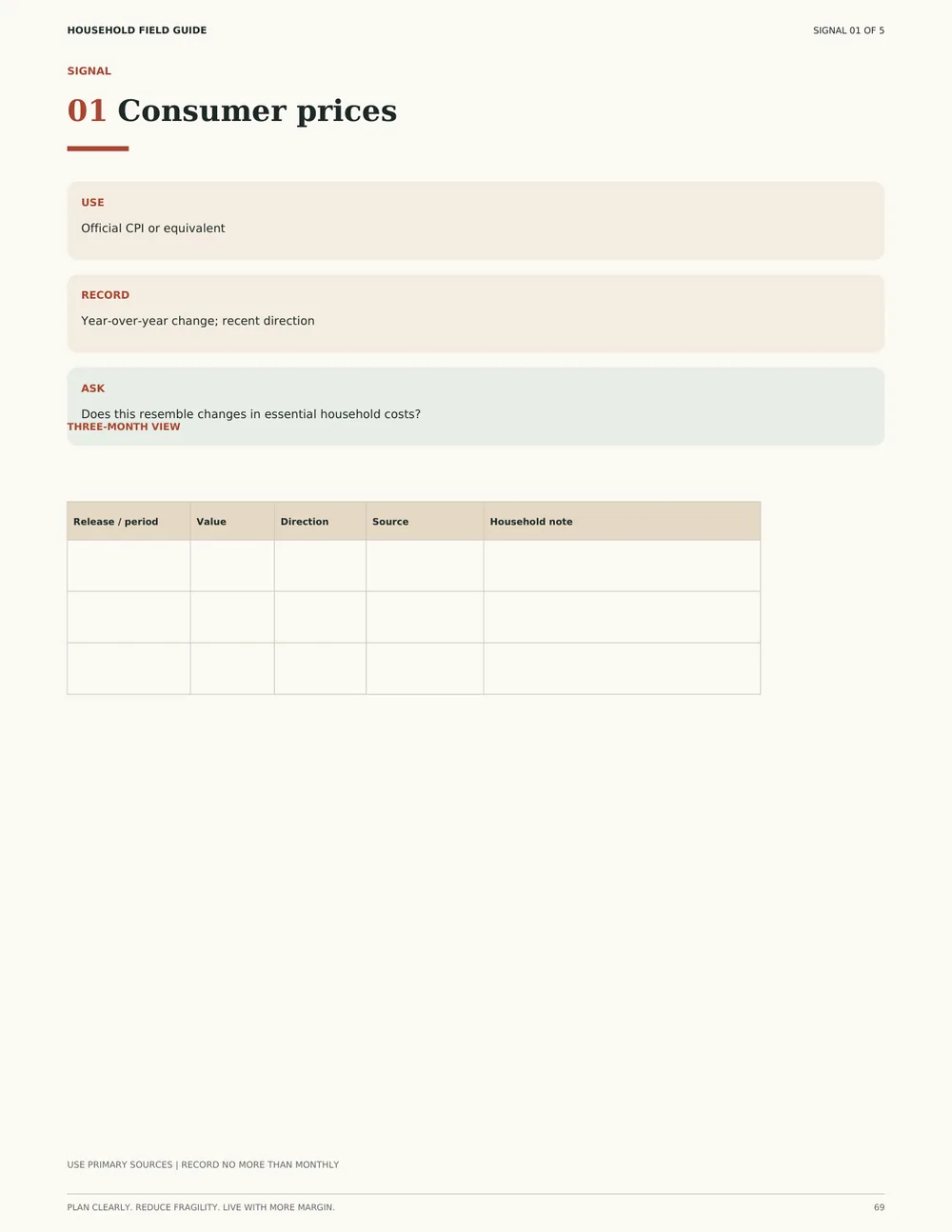
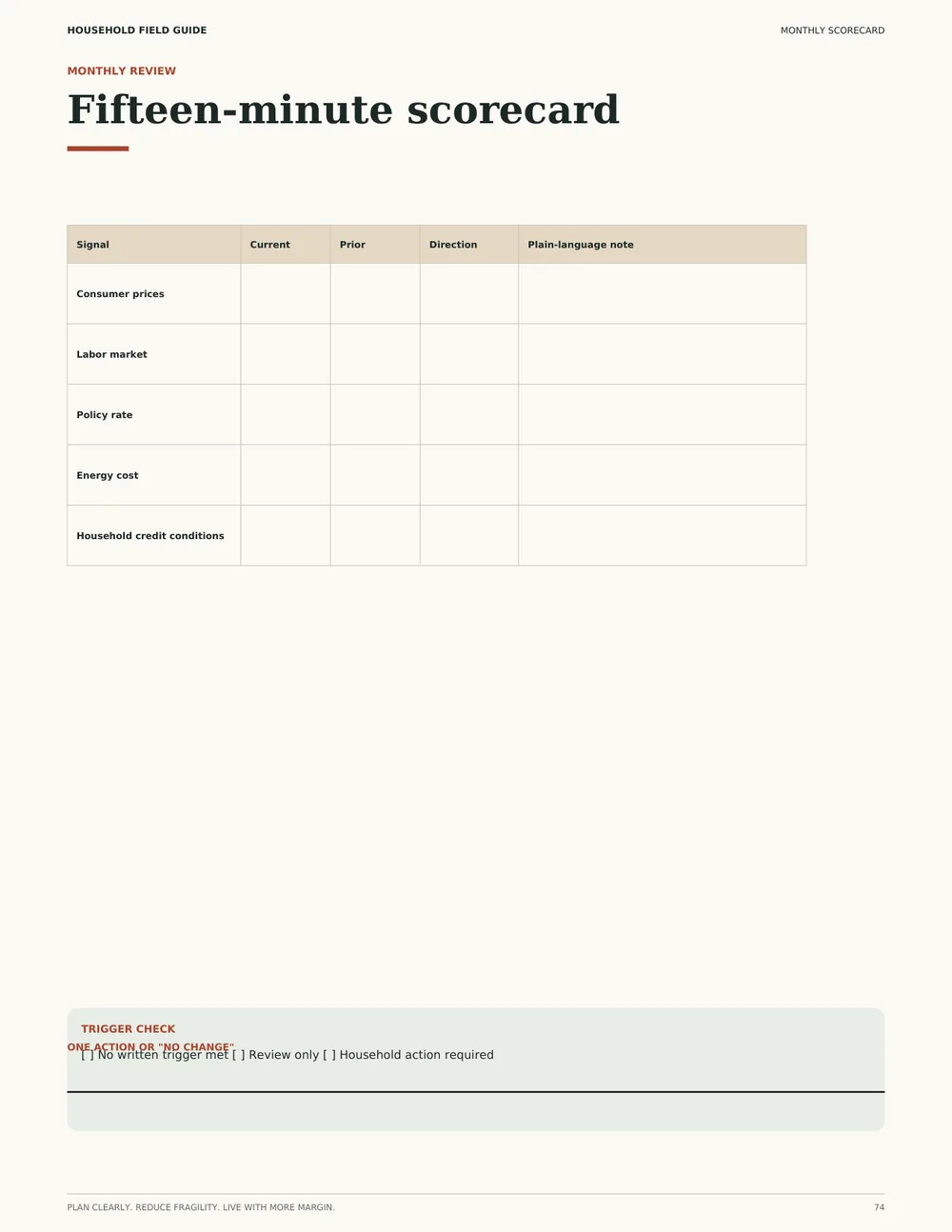
The Economic Indicator Dashboard
Five signals, fifteen minutes a month, taken from official sources. A consistent way to read conditions as context — never as a forecast.
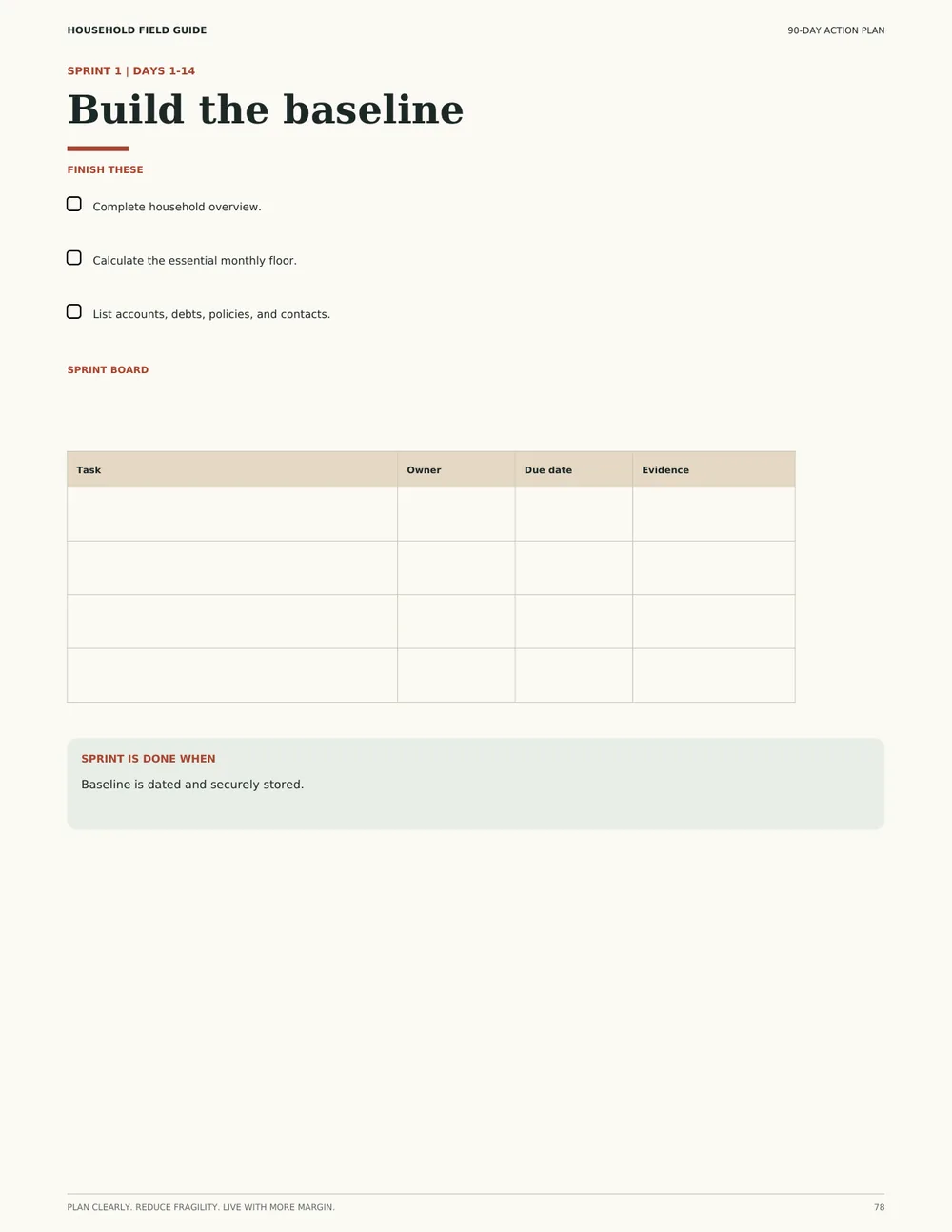
The 90-Day Action Plan
Six two-week sprints that turn preparation into dated, documented, verified change — with a Day 90 review that measures what actually moved.
Look inside
Real pages, not mock-ups
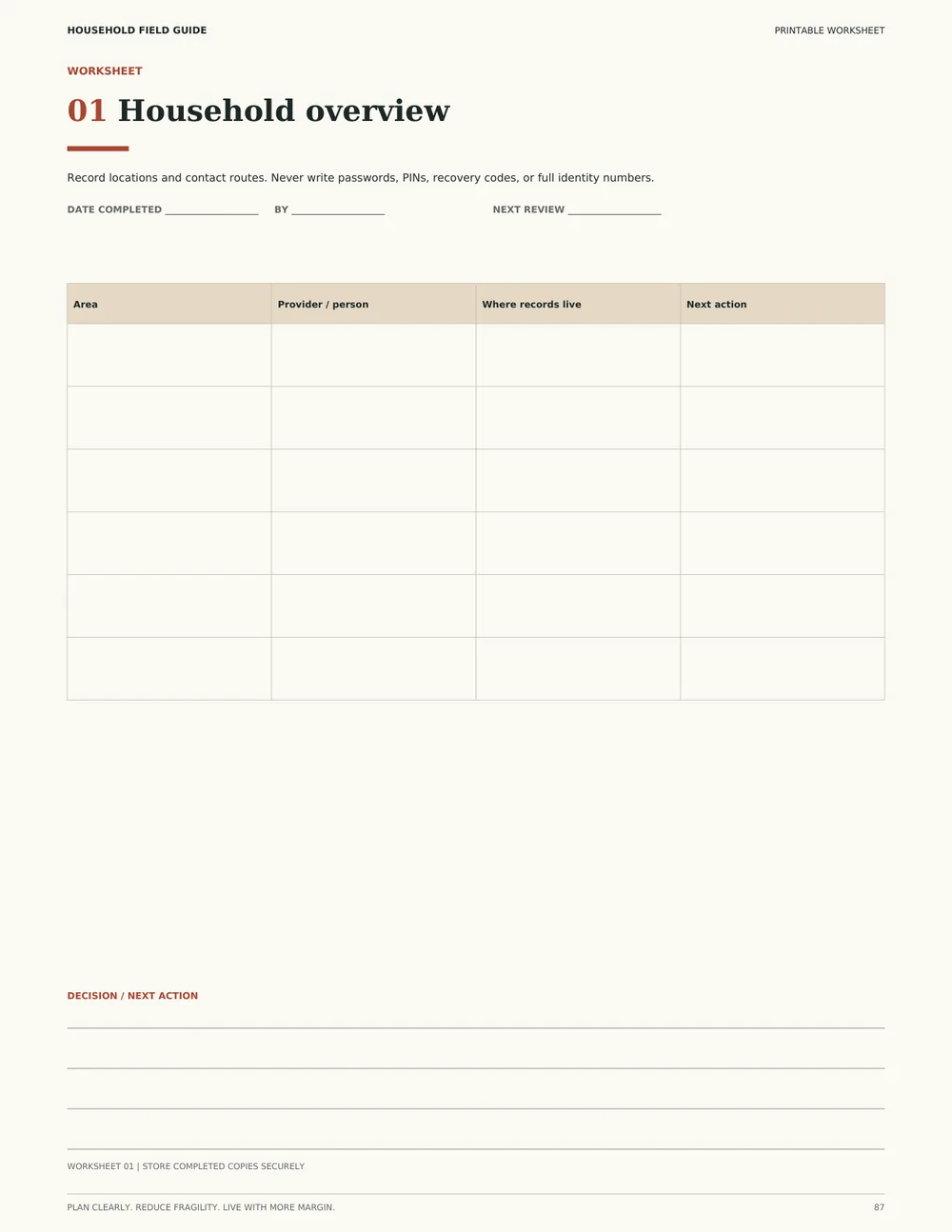
Every image below is an actual page from the guide you will receive.
One complete action
Here is the format, in full
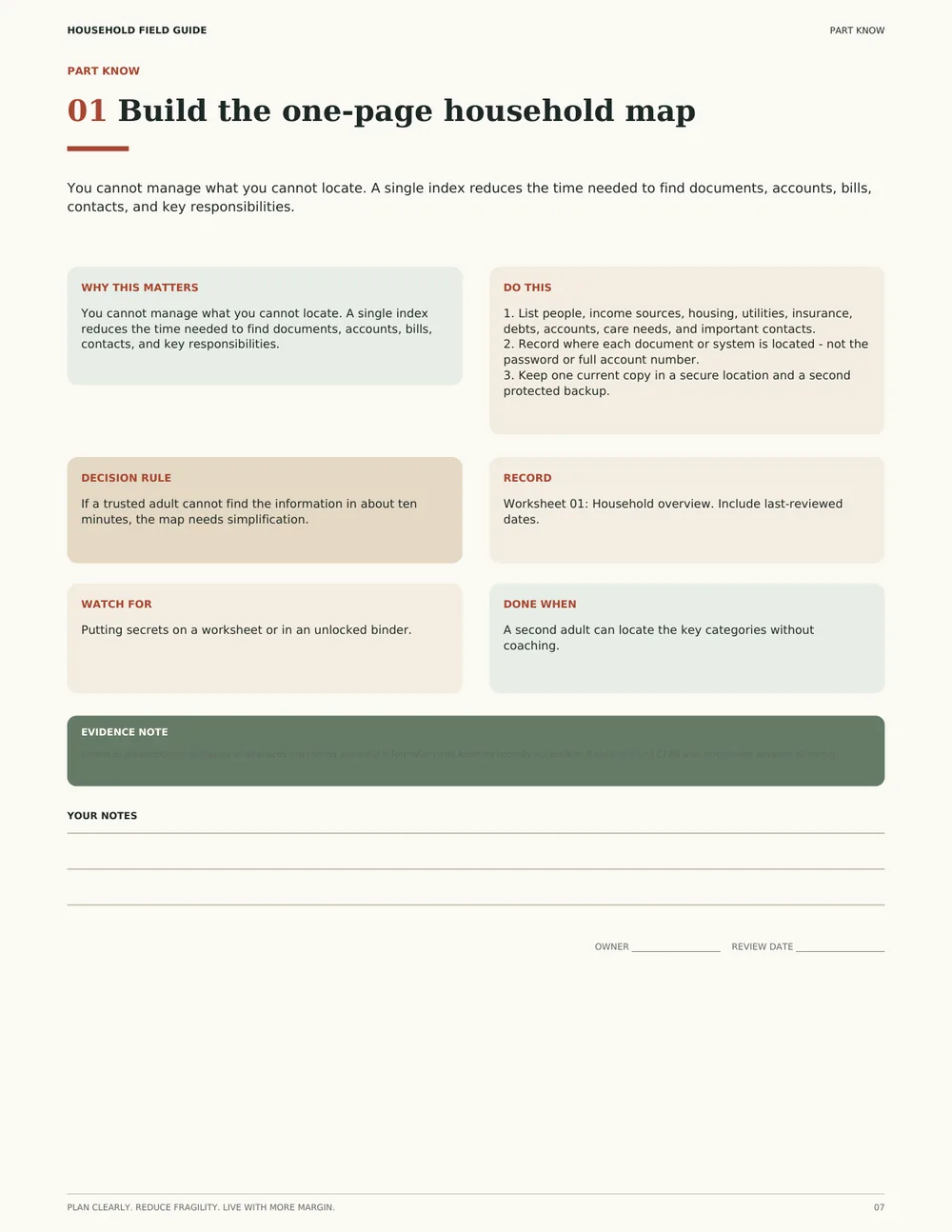
All 47 actions use this same structure, so you never have to work out how to read a page. This is Action 01, reproduced exactly as it appears.
Build the one-page household map
- Why this matters
- You cannot manage what you cannot locate. A single index reduces the time needed to find documents, accounts, bills, contacts, and key responsibilities.
- Do this
- List people, income sources, housing, utilities, insurance, debts, accounts, care needs, and important contacts.
- Record where each document or system is located — not the password or the full account number.
- Keep one current copy in a secure location and a second protected backup.
- Decision rule
- If a trusted adult cannot find the information in about ten minutes, the map needs simplification.
- Record
- Worksheet 01: Household overview. Include last-reviewed dates.
- Watch for
- Putting secrets on a worksheet, or leaving the binder unlocked.
- Done when
- A second adult can locate the key categories without coaching.
- Evidence note
- Financial-preparedness guidance emphasises organising essential information and keeping records accessible; Ready.gov and the CFPB both encourage planning in advance.
Source discipline
Checked against primary sources
The framework was checked against current primary or official sources. Every action carries an evidence note, and the guide includes a live source directory — because guidance and release schedules change, and you should be able to verify rather than trust.
- CFPB
- Ready.gov / FEMA
- CISA
- U.S. Department of Energy
- NAIC
- Bureau of Labor Statistics
- Federal Reserve
- EIA
Honest fit
Who this is for
A good fit if you want to…
- Find any document or account in under ten minutes
- Know the real cost of keeping your household running
- Cut recurring charges you had stopped noticing
- Make sure a second adult can step in and act
- Follow a plan that has an end date and a result
- Work on paper, at your own pace
Not a good fit if you want…
- Predictions about markets or the economy
- Investment picks or personalised financial advice
- Survivalist stockpiling and bunker plans
- An app that does the thinking for you
- Something to read once and shelve
Questions
Before you buy
What exactly do I get?
A single 100-page PDF: the full field guide (47 actions across Know, Reduce, Monitor and Act), plus three companions — the 7-Day Quick Start, the Economic Indicator Dashboard, and the 90-Day Action Plan — and 14 printable worksheets. It is one file, bookmarked so you can jump straight to any section.
How is it delivered?
Immediately after payment you get a download link on screen and by email. There is nothing to install and no account to maintain. Save the file somewhere you will find it again — the guide has opinions about that.
Is this a subscription?
No. It is a one-time payment of $49 for the current edition. There is no recurring charge, no upsell sequence, and no membership.
I am not very good with computers. Can I still use it?
Yes. The PDF opens on any phone, tablet, or computer with no special software, and the text is set large enough to read comfortably on a screen. If you would rather work on paper, the 14 worksheets are designed to be printed on a home printer and use very little ink.
Do I need to be worried about a crisis to find this useful?
No, and that is rather the point. The guide is built for ordinary disruption — a job change, a higher bill, a storm, a power cut, an unexpected repair — rather than for predicting disaster. Most of the work is organisation, not stockpiling.
Is this financial advice?
No. It is educational material about organising a household. It is not individualised financial, tax, legal, insurance, medical, engineering, or emergency-services advice. For investments, complex debt, insurance changes, tax matters, legal documents, and any electrical, gas, or structural work, use a qualified professional. During an active emergency, follow local public-safety instructions.
Where does the information come from?
The framework was checked against current primary or official sources, including the CFPB, Ready.gov/FEMA, CISA, the U.S. Department of Energy, NAIC, the Bureau of Labor Statistics, the Federal Reserve, and the EIA. Every action carries an evidence note, and the guide includes a source directory so you can check the live source yourself. Guidance and release schedules change, so the guide teaches you to check rather than to trust a snapshot.
I am not in the United States. Is it still useful?
Largely, yes. The method — know, reduce, monitor, act — is not country-specific, and the worksheets are neutral. United States sources are named because the framework uses them for illustration; the Economic Indicator Dashboard asks you to record your own country’s official equivalents, and the guide points you to the relevant institution rather than giving legal conclusions.
Get started
Prepared looks ordinary.
It looks like current documents, known costs, tested access, and a household where more than one person can act. That is what the next ninety days can produce.
$49 one-time · instant download
- Instant PDF download
- Read on phone, tablet, or print it
- No subscription, no account needed
- 14-day money-back guarantee
14-day money-back guarantee
Read the whole thing. If it is not useful to your household, email us within 14 days and we will refund you in full — no explanation required, and you keep the file. We would rather have your trust than your $49.