2026 Edition · Version 1.1
The Household Resilience Field Guide
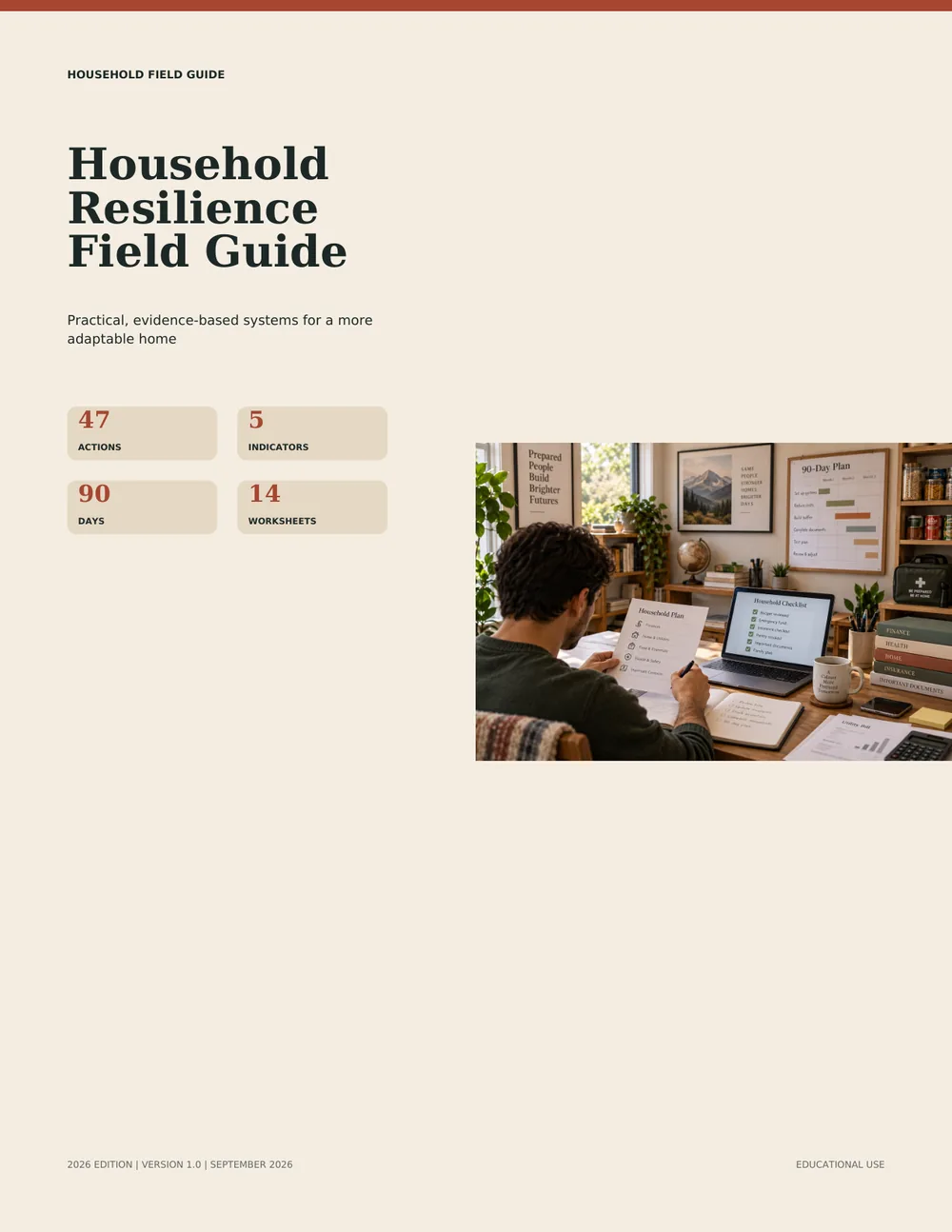
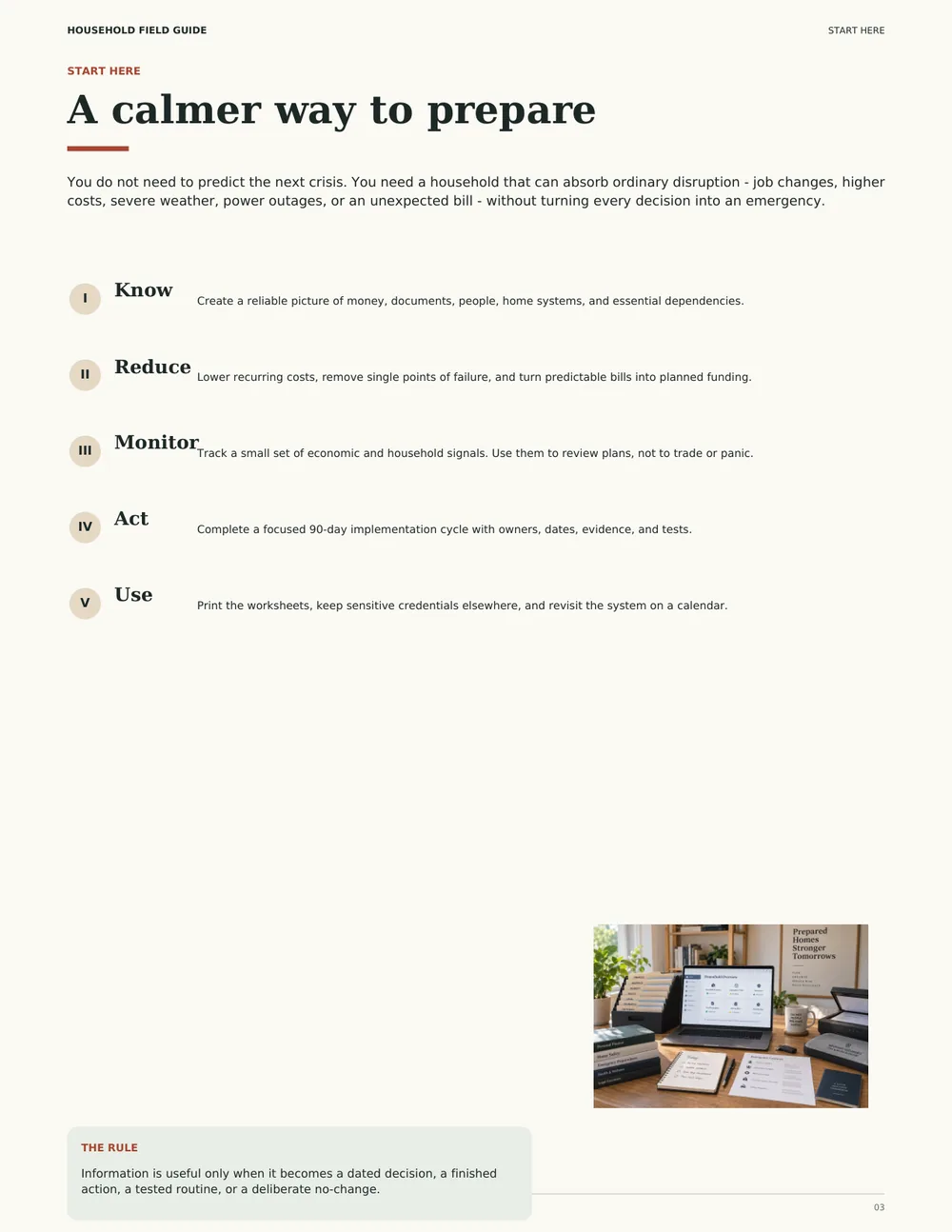
One 100-page PDF. Four parts, three companions, 14 printable worksheets. Bookmarked so you can jump straight to any section, and set large enough to read comfortably on a phone.
- Instant download after checkout, plus an email copy
- Read on phone, tablet, or computer — or print it
- No account to create, nothing to install
- 14-day money-back guarantee
Checkout is handled securely by Whop. We never see or store your card details.
The core guide
All 47 actions
Every action follows the same layout: why it matters, what to do, the decision rule, what to record, what to watch for, when it is done, and the evidence behind it.
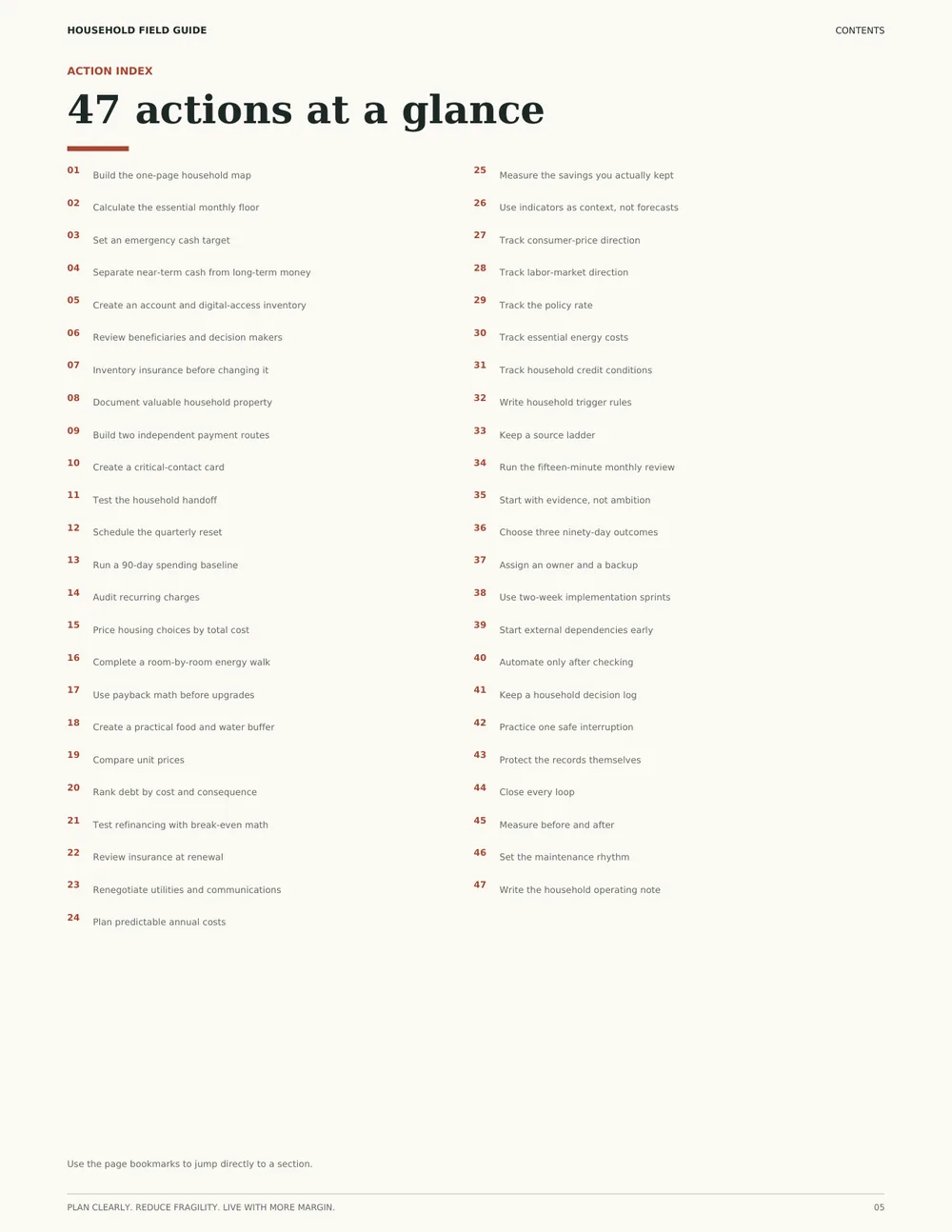
- Build the one-page household map
- Calculate the essential monthly floor
- Set an emergency cash target
- Separate near-term cash from long-term money
- Create an account and digital-access inventory
- Review beneficiaries and decision makers
- Inventory insurance before changing it
- Document valuable household property
- Build two independent payment routes
- Create a critical-contact card
- Test the household handoff
- Schedule the quarterly reset
- Run a 90-day spending baseline
- Audit recurring charges
- Price housing choices by total cost
- Complete a room-by-room energy walk
- Use payback math before upgrades
- Create a practical food and water buffer
- Compare unit prices
- Rank debt by cost and consequence
- Test refinancing with break-even math
- Review insurance at renewal
- Renegotiate utilities and communications
- Plan predictable annual costs
- Measure the savings you actually kept
- Use indicators as context, not forecasts
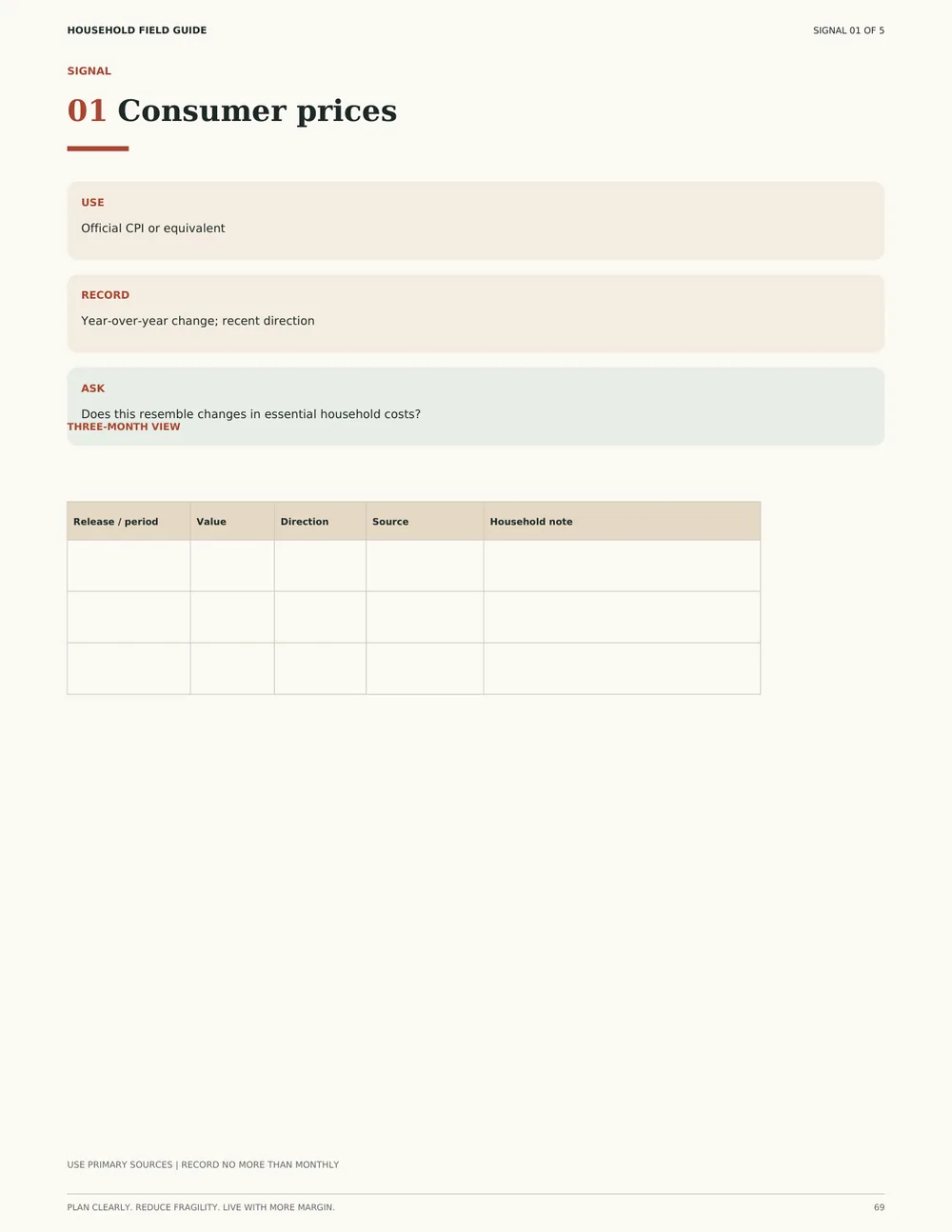
- Track consumer-price direction
- Track labor-market direction
- Track the policy rate
- Track essential energy costs
- Track household credit conditions
- Write household trigger rules
- Keep a source ladder
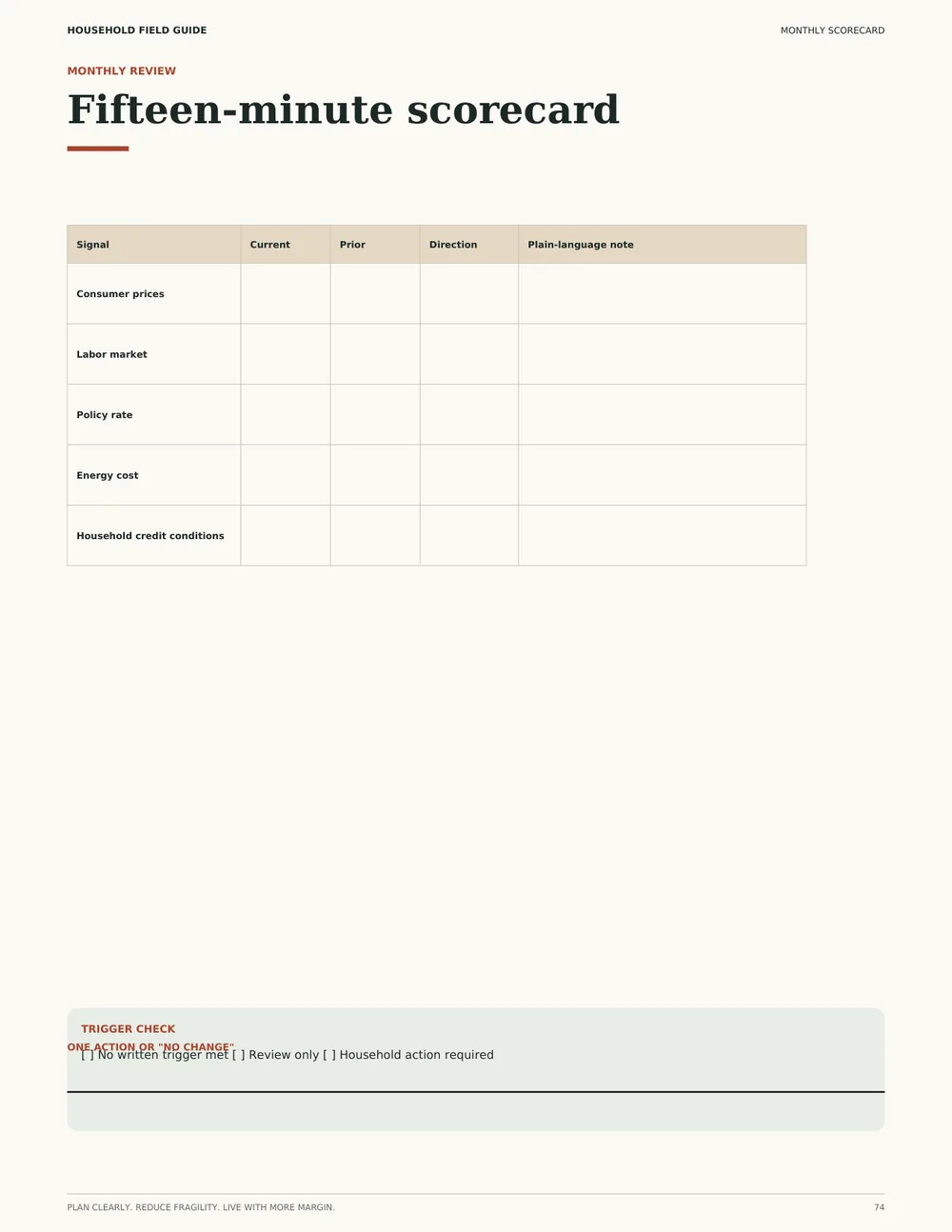
- Run the fifteen-minute monthly review
- Start with evidence, not ambition
- Choose three ninety-day outcomes
- Assign an owner and a backup
- Use two-week implementation sprints
- Start external dependencies early
- Automate only after checking
- Keep a household decision log
- Practice one safe interruption
- Protect the records themselves
- Close every loop
- Measure before and after
- Set the maintenance rhythm
- Write the household operating note
Companion 1
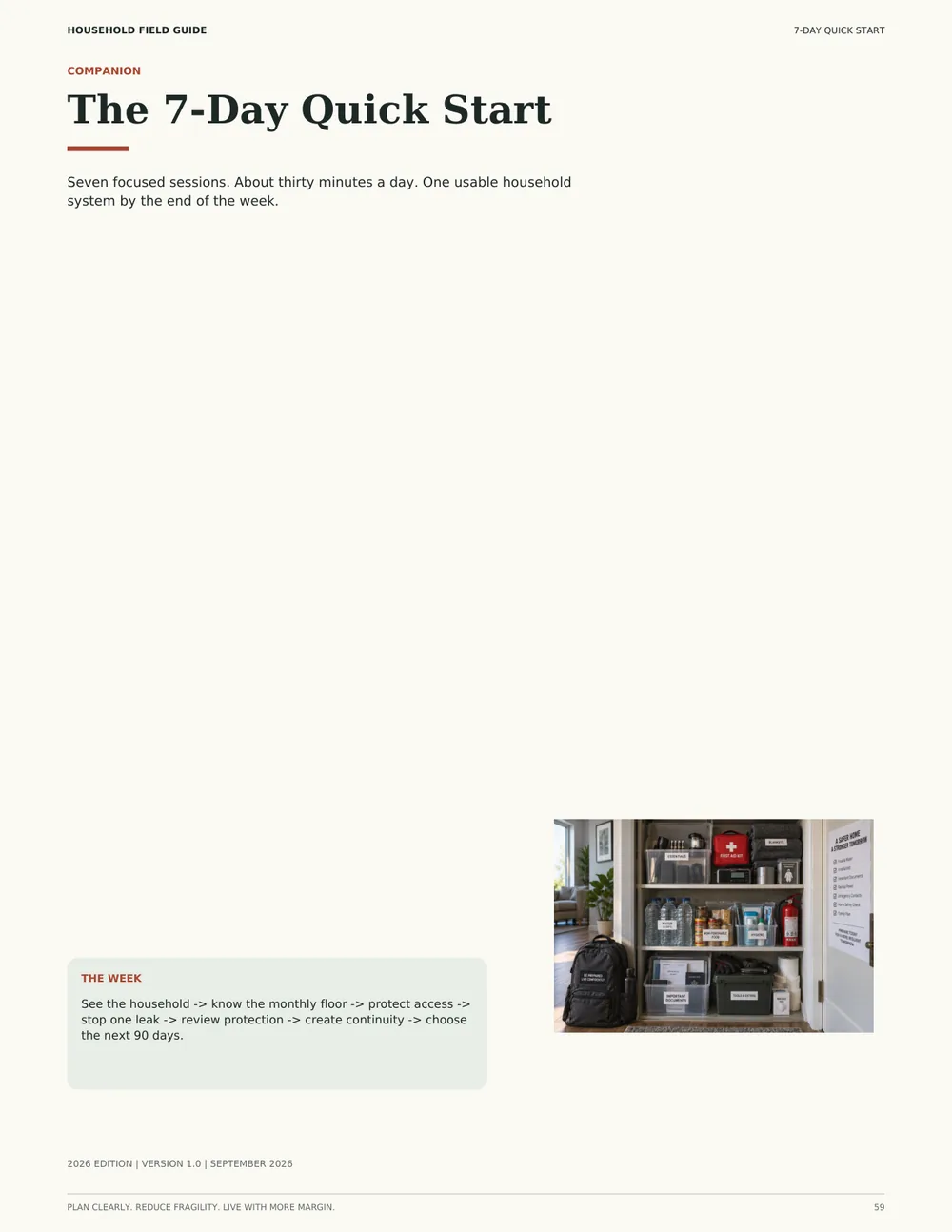
The 7-Day Quick Start
Seven focused sessions, about thirty minutes a day. Start here if ninety days feels like too much to commit to on day one.
Day 1
See the household
List income, essential bills, accounts, debts, policies, and key contacts.
Day 2
Know the monthly floor
Use recent statements to calculate what it truly costs to keep running.
Day 3
Protect access
Confirm account recovery details and identify a backup payment route.
Day 4
Stop one leak
Scan statements for recurring charges. Cancel or downgrade one.
Day 5
Review protection
List active policies with limits, deductibles, exclusions, and renewal dates.
Day 6
Create continuity
Show another adult the overview. Practise finding a policy without coaching.
Day 7
Choose the next 90 days
Pick one liquidity, one recurring-cost, and one continuity outcome.
Companion 2
The Economic Indicator Dashboard
Five signals. Fifteen minutes a month. Update the same five fields from primary sources, compare direction over time, and write one plain-language note — as context for reviewing plans, never as a forecast or a reason to trade.
| Signal | What to use | What to record |
|---|---|---|
| 01 · Consumer prices | Official CPI or equivalent | Year-over-year change and recent direction |
| 02 · Labor market | Official employment release | Unemployment and the employment trend |
| 03 · Policy rate | Official central-bank decision | Current rate and the next meeting or reset |
| 04 · Energy cost | Official energy source | One fuel or household-energy measure that matters to you |
| 05 · Household credit conditions | Your statements plus official sources | Variable rates, promotional end dates, payment changes |
Companion 3
The 90-Day Action Plan
Three outcomes only — one for liquidity, one for recurring costs, one for continuity — delivered across six two-week sprints, then measured on Day 90.
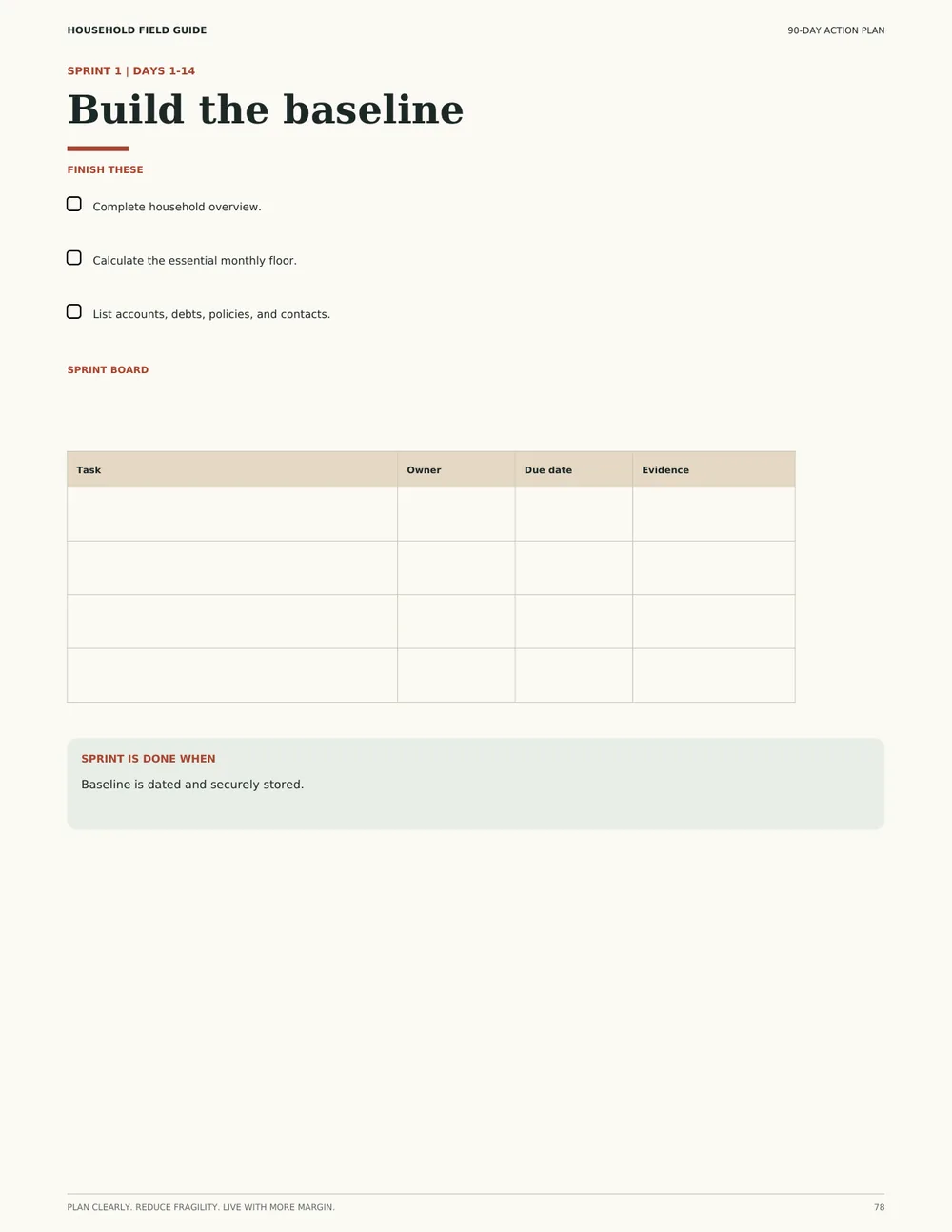
Days 1–14
Build the baseline
Complete the household overview and calculate the essential monthly floor.
Days 15–28
Protect access
Confirm recovery details and a backup payment route. Review designations.
Days 29–42
Reduce recurring pressure
Audit recurring charges and complete the room-by-room energy walk.
Days 43–56
Review debt and protection
Map debt terms and deadlines. Inventory insurance before changing anything.
Days 57–70
Build the dashboard
Save the official source links and record the first observations.
Days 71–90
Close the loop
Verify changes on statements. Run one safe continuity test. Measure the change.
Printable tools
Fourteen low-ink worksheets
Designed for household decisions, secure record-keeping, and a home printer. Record where things are and who can act — never passwords, PINs, recovery codes, or full identity numbers.
- Household overview
- Essential monthly floor
- Buffer builder
- Account inventory
- Document and contact index
- Coverage review
- Payment continuity plan
- Spending baseline
- Recurring-cost sweep
- Decision comparison
- Home energy walk
- Pantry and essentials
- Debt map
- Quarterly review
Look inside
Sample pages
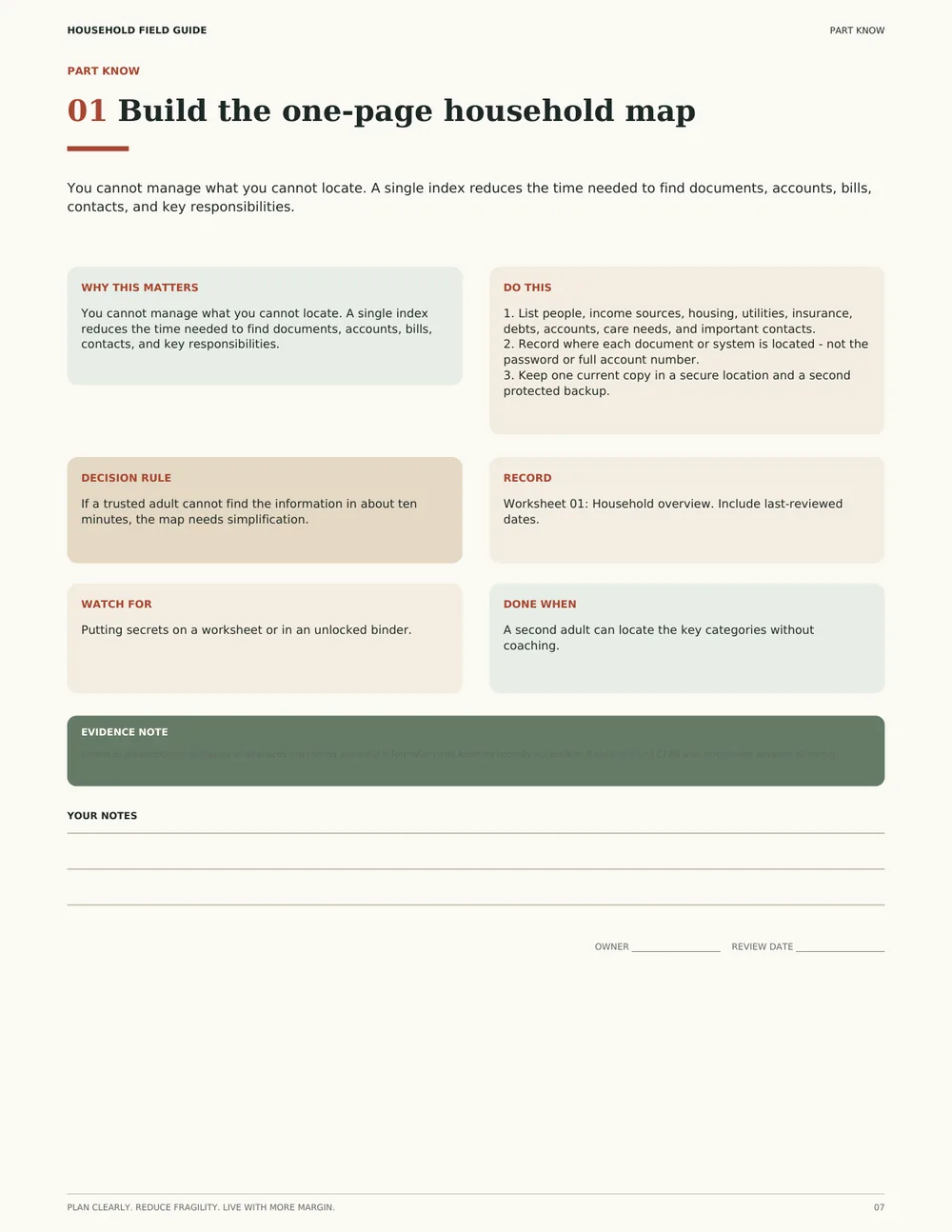
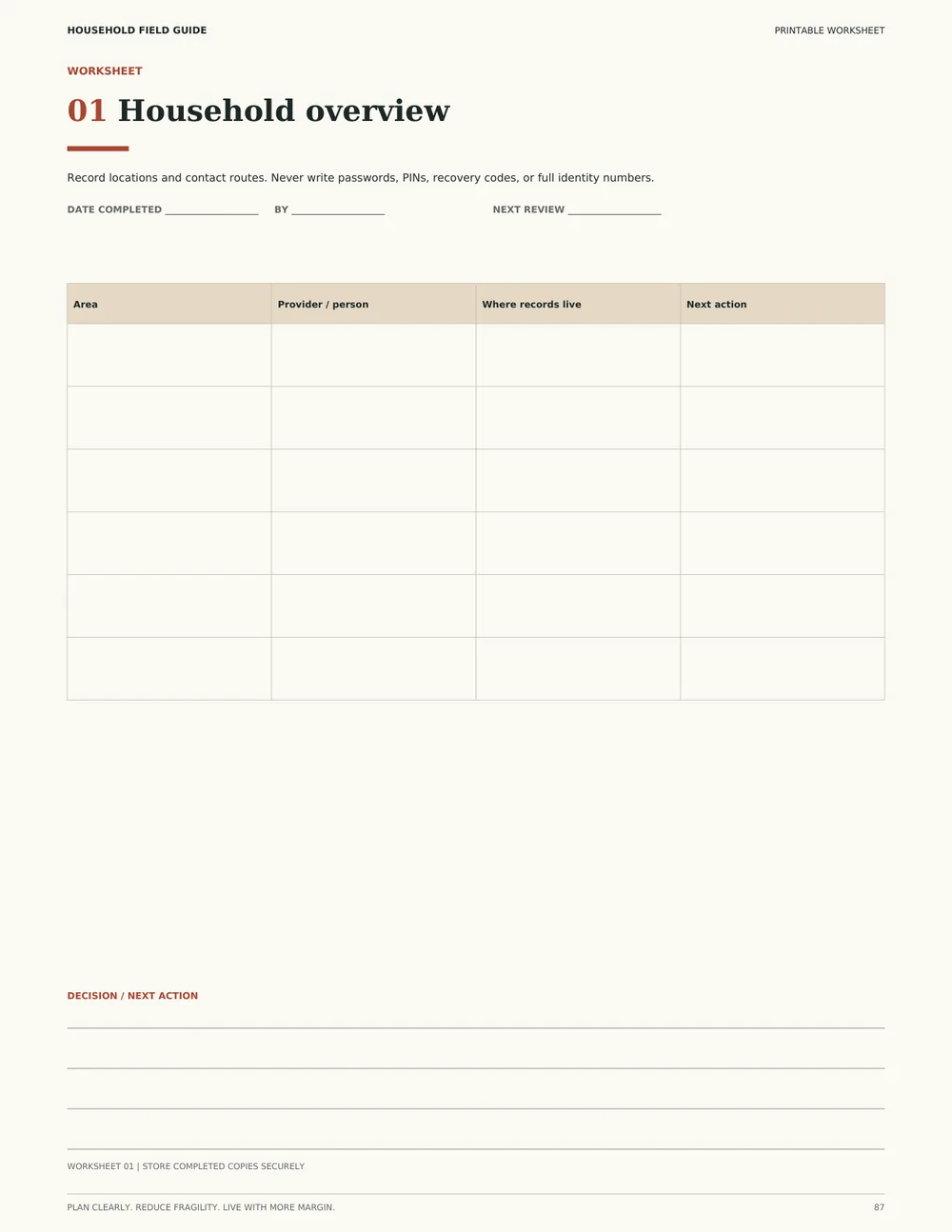
Build the one-page household map
- Why this matters
- You cannot manage what you cannot locate. A single index reduces the time needed to find documents, accounts, bills, contacts, and key responsibilities.
- Do this
- List people, income sources, housing, utilities, insurance, debts, accounts, care needs, and important contacts.
- Record where each document or system is located — not the password or the full account number.
- Keep one current copy in a secure location and a second protected backup.
- Decision rule
- If a trusted adult cannot find the information in about ten minutes, the map needs simplification.
- Record
- Worksheet 01: Household overview. Include last-reviewed dates.
- Watch for
- Putting secrets on a worksheet, or leaving the binder unlocked.
- Done when
- A second adult can locate the key categories without coaching.
- Evidence note
- Financial-preparedness guidance emphasises organising essential information and keeping records accessible; Ready.gov and the CFPB both encourage planning in advance.
Start the next ninety days
One file. One method. An end date, and something to show for it.
$49 one-time · instant download
- Instant PDF download
- Read on phone, tablet, or print it
- No subscription, no account needed
- 14-day money-back guarantee
14-day money-back guarantee
Read the whole thing. If it is not useful to your household, email us within 14 days and we will refund you in full — no explanation required, and you keep the file. We would rather have your trust than your $49.